
Social ROI Reporter
Ayzenberg Agency | Soulmates.AI team
INTRO The Ayzenberg Agency, California’s largest independent creative agency, has spent years compiling its industry gold-standard Earned Media Value (a.EMVI). By evaluating numerous data sources, the a.EMVI assigns a dollar value to social media engagements. This allows marketers an entirely cutting edge way to evaluate their return on investment when looking at their social media advertising efforts. The team maintaining and evolving the a.EMVI is known internally as Soulmates.AI, the team on which I work.
CHALLENGE I was tasked with designing a digital product from strong initial interest in the a.EMVI numbers, released in a quarterly white-paper. I was also charged with incorporating an internally-used, client-facing API of the a.EMVI numbers, into aforementioned soon-to-be fully-fledged digital product, making it ready for sale and subscription as soon as possible.
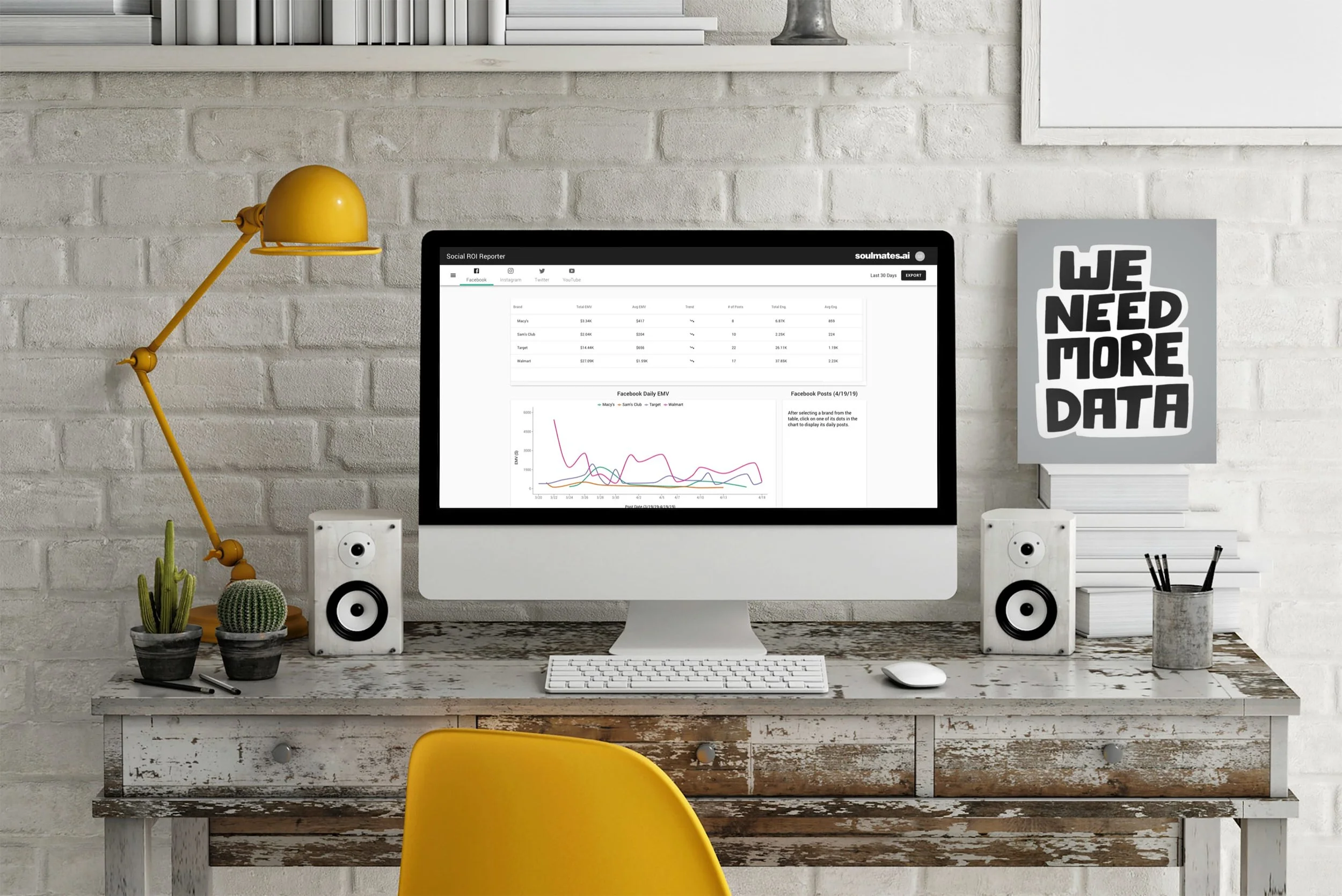
SUCCESS I led design on an entirely new product, what we came to call the Social ROI Reporter. Utilizing the user-centered design process, I iterated and saw through to deployment an entire design system for Ayzenberg’s a.EMVI product. The product is now in use at teams both internally and externally, allowing Fortune 50 companies to make better decisions faster.
Customer Interest
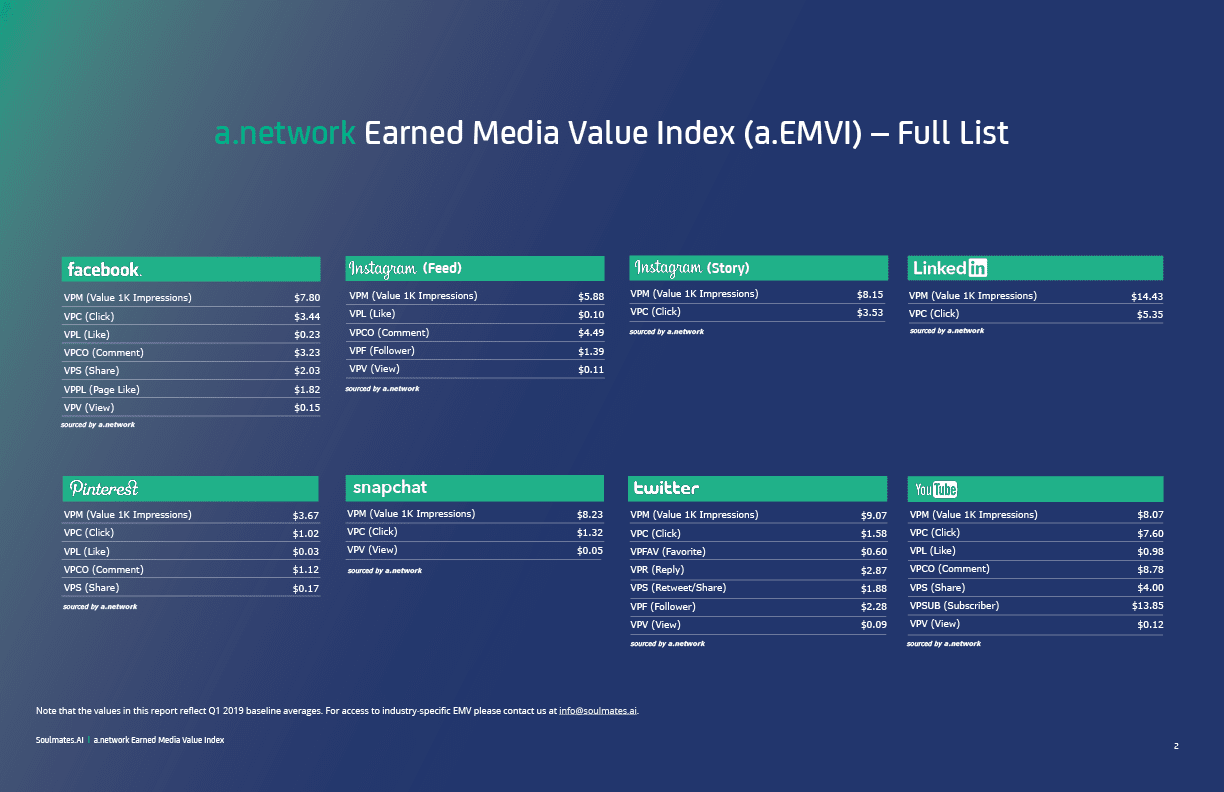
WHITEPAPER The soulmates team had been releasing quarterly white-papers with a.EMVI values to rave reviews. Marketers, agencies, and influencers were all excited to have access to these new, game-changing numbers. However, the lag time between updates and the manual process of working with numbers in a PDF was a major weakness for the a.EMVI.
API Internally an API had been developed to allow in-house teams to report on the a.EMVI with some of their big name clients. Chief among them Microsoft’s XBOX team and Facebook’s Oculus teams. These big name clients responded well to seeing the a.EMVI metric alongside traditional reporting metrics, and internal teams loved the flexibility the API had. However, once when we began selling access to the API, customers quickly began asking for a product solution to meet their reporting needs.
User Interviews
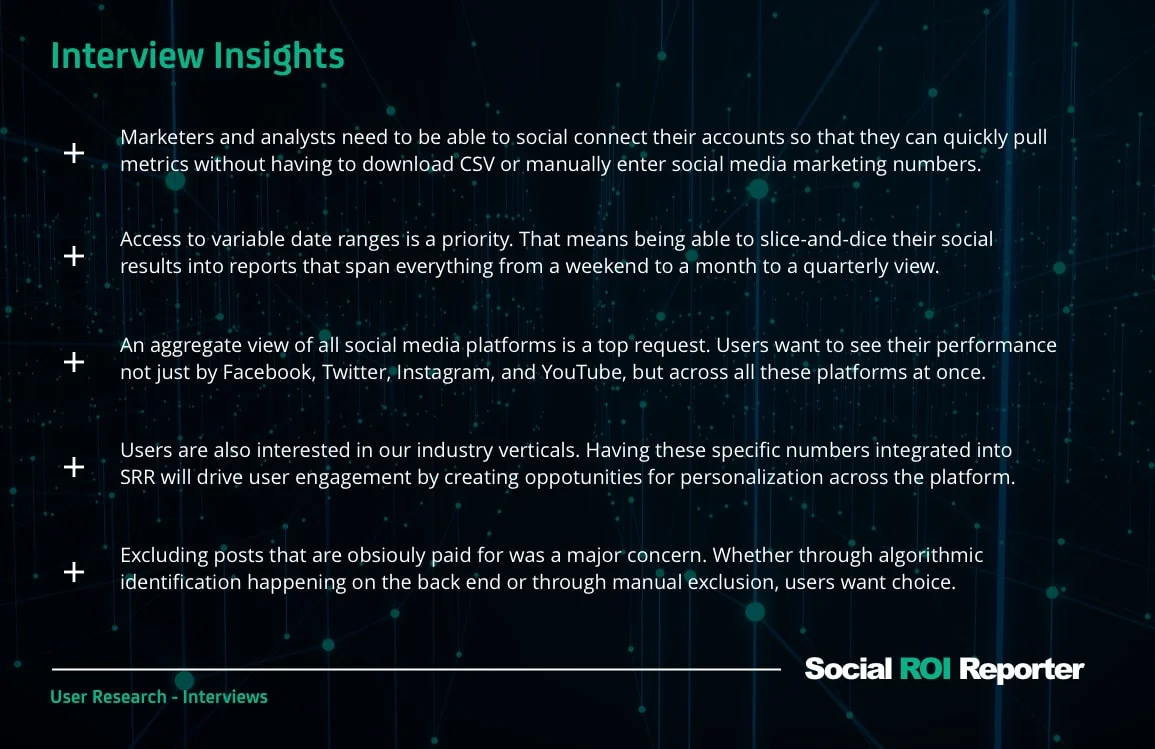
FEEDBACK & INSIGHT We began seeking out our target users from the personas that we had developed. We had a great list of interested users from subscribers to our quarterly reports and those who had downloaded and used our API. I scheduled interviews with users that fell into each of our primary and secondary personas. From those interviews I was able to identify key pieces of software they were currently using, processes in their daily work, and ideas for solutions that they were already specifically seeking out. Below were my insights that I brought back to my team.
Sketches & Mid-Fi
WHITEBOARDING At this stage in my process, I like to do tons of hand-drawn whiteboard sketches. I intentionally start from a mobile-view because I believe the limitations in screen real-estate provide the creative challenge that pushes me to cut the fat and deliver only on the most essential elements of my designs. I also love to bring in other team members and stakeholders at this messiest of the design phases. Sketches often quickly shift into mind-mapping and idea trees, as the rough concepts of a design can take shape through visual avenues beyond user interface representations. Their input, questions, concerns and excitement are all invaluable at this stage.
INVISION PROTOTYPE Using industry best practices, I built and collaboratively shared a clickable prototype using Sketch and Invision. This allowed me to quickly share my design decision making with my team, while gathering valuable feedback quickly. It also allowed us to share initial designs with internal stakeholders and team members who were also within our user personas. I love doing these mid-fi designs because I can move quickly my using wire-framing principles, but also drill down on specific features and functionality. I love adding color, icons, and affordances to barebones pieces, allowing me to see the skeletons of my designs come to life.
Implementation
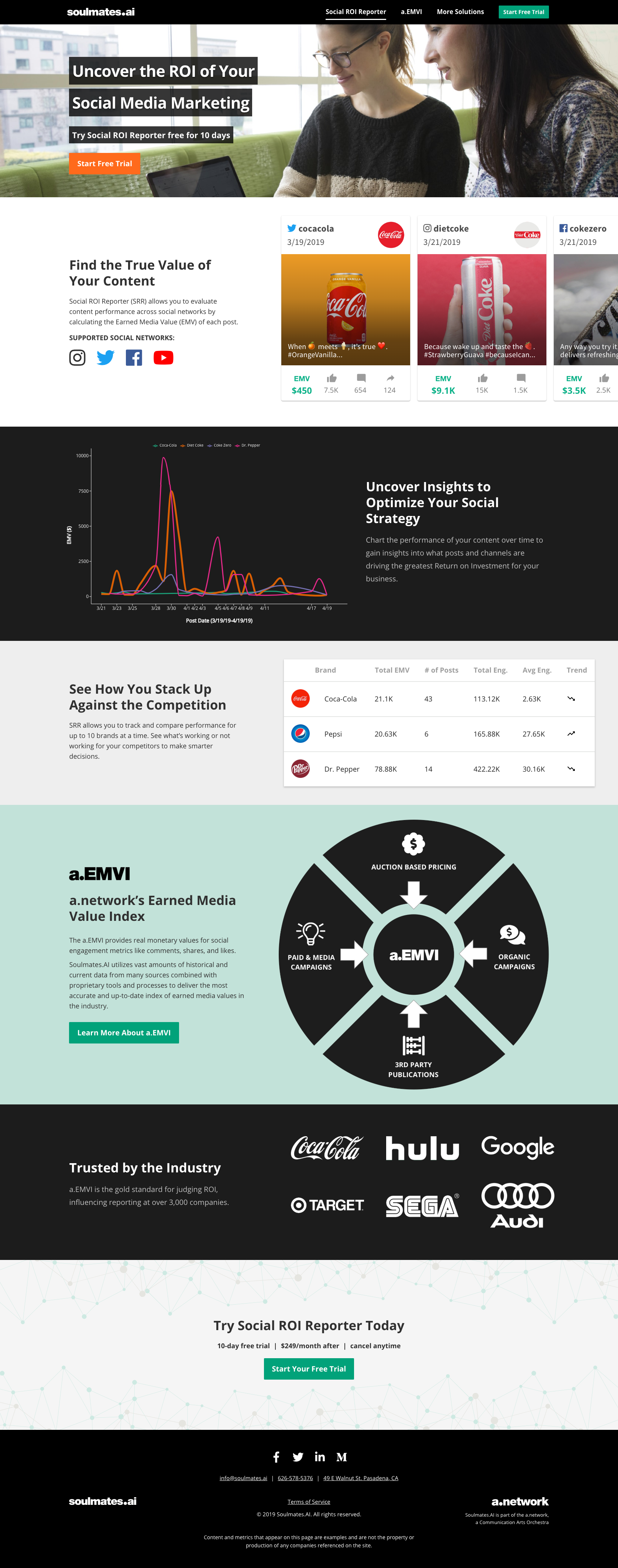
MARKETING SITE Since this product was built from scratch, I also contributed extensively to our marketing site. I designed a site aimed at converting visitors into paying customers. As well I wanted to give our current users a place to better understand what our product does, who are team is and more about the solutions we work so hard to provide. I used a very similar design process to the product itself, starting with kick-off meetings and requirements gathering, moving to sketches and mid-fi and working hand in hand with our dev team to build an entirely React based website, moving away from our clunky old Wordpress site.
User-testing and Next Steps
ITERATIVE PROCESS With active users on our platform, I was able to reach out to them directly and schedule testing sessions. From our analytics, I had several areas I wanted to get qualitative feedback on, areas where we had expected users to go deeper into our product but they demonstrably were not. After drilling down on several issues with these users, I identified clear areas of improvement. I took these findings back to our product lead and senior stakeholders to find how we could align business goals with our next steps.
Screen recordings from guided user testing. One of the most fascinating findings was our users’ willingness to infer complex conclusions from the baseline visualizations we were supplying them. Our users are sharp and we’ve given them the tools to be extremely effective!
Screen recordings from guided user testing. Our users don’t always want sexy designs. Simply providing clean, straight forward data visualizations is often the most compelling piece of our platform. As well, using a design system like Google’s Material Design gives them a familiar, predictable library of interactions with which users come ready to engage meaningfully.